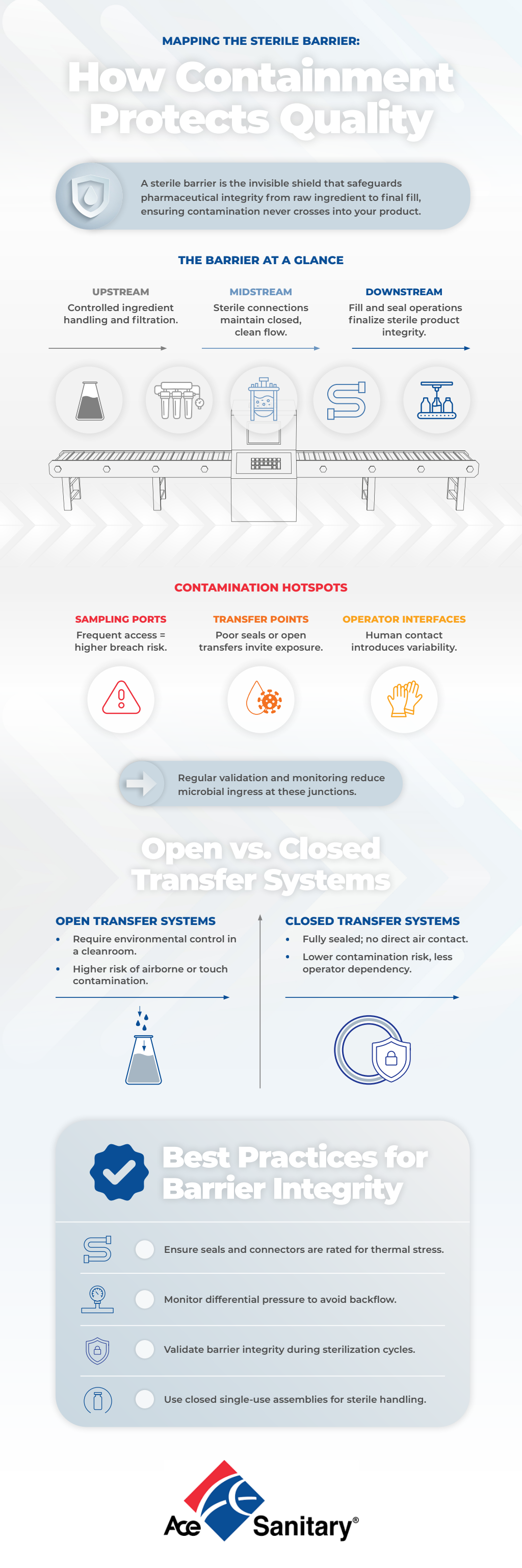
In sanitary processing environments, sterility is not achieved through a single control point. It is the result of a carefully designed system that maintains protection at every stage of production. Containment plays a central role in that system. It preserves product integrity, supports regulatory compliance, and reinforces the trust customers place in the final outcome.
Protection starts well before production is underway. Raw material handling sets the tone for everything that follows. Equipment geometry, material compatibility, and overall system design determine how resilient the process will be to contamination risks downstream. Smooth internal surfaces, reduced dead zones, and materials engineered for hygienic use help establish a strong foundation for sterility from the very beginning.
As product flows through the system, complexity increases. Each transfer, connection, or sampling point introduces potential vulnerability. Effective containment strategies account for these moments by limiting exposure and maintaining control throughout the process. Consistency becomes critical. Every time components are assembled or disconnected, precision matters. Properly selected fittings, accurate installation, and validated connections reduce variability and reinforce system reliability.
Closed transfer solutions further strengthen containment by eliminating unnecessary interaction between product and environment. Rather than relying on controlled spaces and manual handling, closed systems are designed to minimize exposure altogether. This reduces the risk of contamination while improving repeatability and operational efficiency. Fewer open steps also mean less time spent on cleaning, inspection, and requalification.
System integrity must also hold up under real-world operating conditions. Changes in pressure, temperature, and repeated sterilization cycles place ongoing stress on seals and connectors. Materials must be capable of maintaining performance without degrading over time. Routine inspection, leak detection, and validation help confirm that containment remains intact and that small issues are addressed before they escalate.
Containment is not achieved through a single component. It is built through intentional design choices across the entire system. When every hose, fitting, and connection supports hygienic performance, the process becomes more resilient as a whole. Strong containment does more than prevent contamination. It protects the quality of the product, the efficiency of the operation, and the confidence of everyone who relies on the system to perform as intended.
To explore best practices for building sterile containment systems and maintaining sanitary hardware, review our accompanying resource on mapping the sterile barrier from Ace Sanitary, experts in biopharmaceutical tubing.