
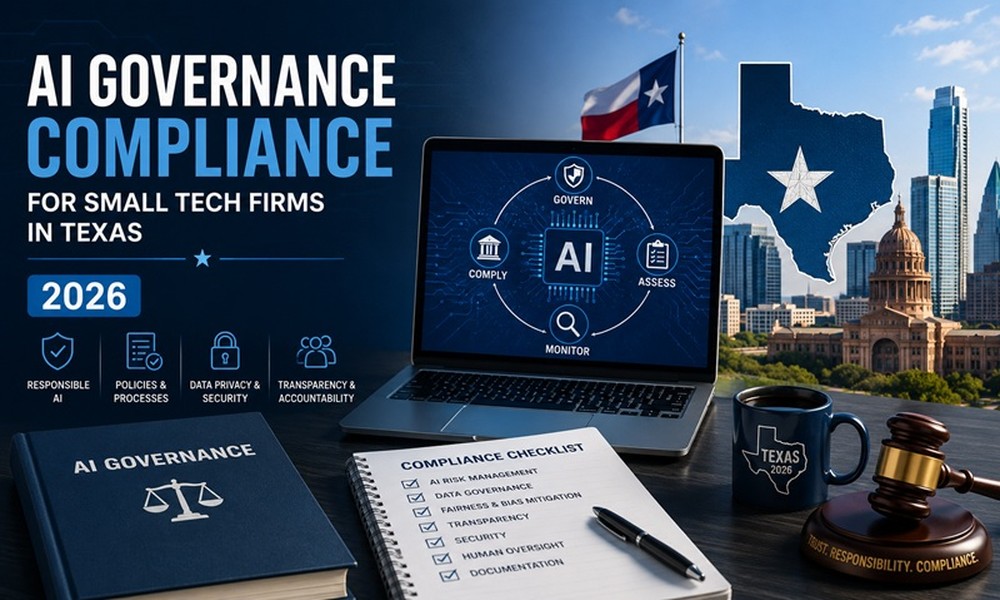
For small tech companies in Texas, AI governance has shifted from an abstract concern to a practical business requirement in 2026. New federal guidelines, evolving state-level discussions, and client contracts that increasingly include AI compliance clauses mean that small firms without a governance framework are carrying real risk. This guide explains what AI governance compliance means for small Texas tech firms and where to start.
What AI Governance Means in 2026
AI governance refers to the policies, processes, and documentation that ensure AI systems used within a business – whether built internally or sourced from vendors – operate transparently, fairly, and within applicable legal boundaries. For small tech firms, this typically involves three overlapping areas: risk assessment for AI use, documentation of AI decision-making processes, and contractual compliance with clients who have their own AI policies.
The Regulatory Landscape for Texas Tech Firms in 2026
Federal Level
The US AI governance landscape in 2026 remains primarily shaped by executive guidance, NIST’s AI Risk Management Framework (AI RMF 1.0), and sector-specific regulations (healthcare AI, financial AI, and federal contractor requirements). No single comprehensive federal AI law has passed as of mid-2026, but federal agency guidance carries real weight for firms working with government clients or in regulated industries.
Texas State Level
Texas has been more business-friendly in its AI approach than California or the EU, but that doesn’t mean there are no considerations. Texas HB 4697 and related proposals have introduced discussions around algorithmic transparency for consumer-facing applications. Firms working with Texas government contracts should monitor procurement requirements closely.
Practical AI Governance Steps for Small Texas Tech Firms
- Inventory your AI use. Document every AI tool used in your business – including SaaS tools with embedded AI – and what decisions or outputs it influences.
- Conduct a basic risk assessment. For each AI use, ask: What goes wrong if this produces an incorrect output? Who is affected? How consequential is the error?
- Implement human review checkpoints. High-stakes AI outputs – those affecting hiring, credit, client deliverables, or safety – should have documented human review before acting on them.
- Create an AI use policy. A one-page internal policy outlining acceptable AI use, data handling, and disclosure requirements is often enough for small firms to satisfy initial client compliance requirements.
- Review vendor agreements. If you use OpenAI, Anthropic, Google, or other AI provider APIs, understand their terms around data use, retention, and liability. These terms matter in client contracts.
Common Mistakes to Avoid
Assuming you’re too small to be affected: Small firm status is not a governance exemption. Client contracts, especially with enterprise or government buyers, increasingly include AI compliance requirements regardless of vendor size.
Conflating cybersecurity compliance with AI compliance: SOC 2 and ISO 27001 certifications address data security, not AI decision-making transparency. They’re complementary, not interchangeable.
Building without documentation: If your firm builds AI-assisted products for clients, the ability to explain how your AI works – in plain terms – has become a sales and legal requirement, not just a technical nice-to-have.
FAQs
Does Texas have specific AI laws in 2026? Texas has not enacted comprehensive AI legislation as of mid-2026, but sector-specific and procurement-related requirements exist. Monitor the Texas Legislature Online for current bill status.
What is the NIST AI RMF? The National Institute of Standards and Technology’s AI Risk Management Framework provides a voluntary but widely adopted structure for identifying, assessing, and managing AI risk. It’s the most practical starting point for small firms building a governance framework.
Do I need a dedicated AI compliance officer? Not immediately. For small firms, assigning AI governance responsibility to an existing technical lead or operations manager – with documented responsibilities – is a practical starting point.
How do I respond to client AI compliance questionnaires? Develop a standard AI use disclosure document that covers: what AI tools you use, for what purpose, what human oversight exists, and how data is handled. This covers most questionnaire requirements.
Conclusion
AI governance for small Texas tech firms in 2026 doesn’t require a legal department or expensive consultants to get started. Begin with an inventory of your AI tools, a simple risk assessment, and a one-page AI use policy. Build documentation habits now – before a client contract or regulatory question requires you to reconstruct them under pressure.